
3 times champions crumbled under pressure in a championship fight
If you watch enough title fights, you start noticing the same thing. The big moments don’t come out of nowhere. They usually show up after someone makes a small mistake – wrong timing, poor distance, a rushed decision.
At that level, everyone can fight. What actually separates people is how they react once things stop going their way and there’s no time to reset or rethink the plan. Here are some of the biggest boxing upsets in history and what contributes to these huge events.
Boxing upsets – Pressure changes how the brain works
Under pressure, the brain doesn’t slow down – it narrows. Options that seem obvious in training suddenly disappear. Fighters stop processing the full situation and focus on whatever feels most urgent.
This is why experienced fighters often look calmer, even when they’re losing. They’ve learned to limit emotional spikes and keep their decision-making simple. Instead of reacting to every moment, they stick to a few clear priorities.
Less experienced fighters often do the opposite. They rush exchanges, force openings, or abandon structure entirely. The pressure doesn’t make them weaker. It makes their choices louder and less controlled.
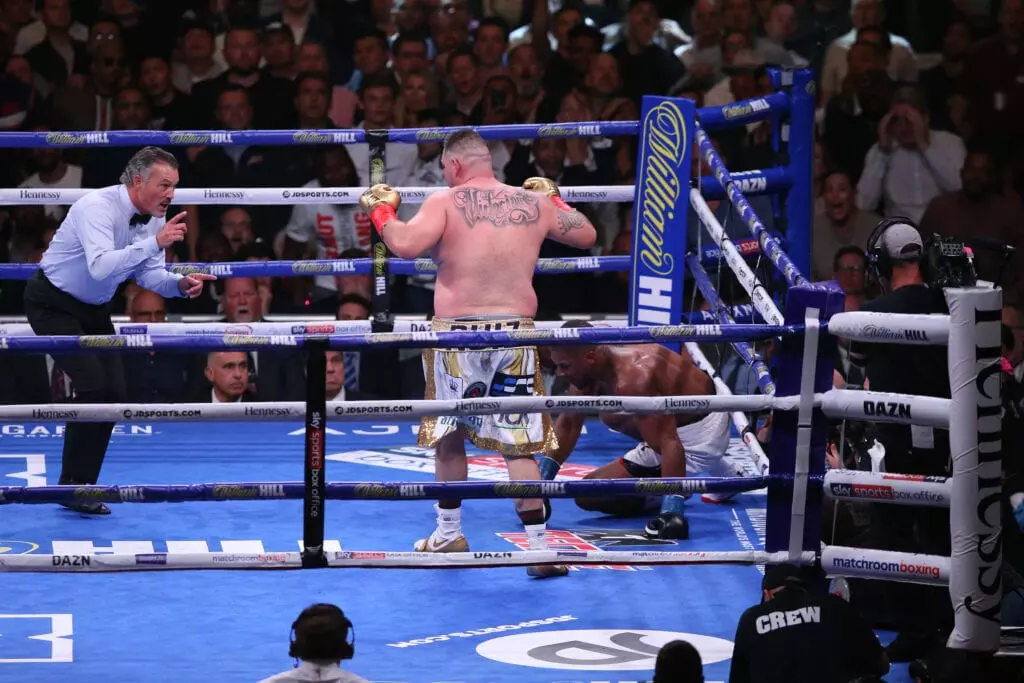
Joshua vs Ruiz 1 remains one of the biggest boxing upsets. Late-replacement Ruiz was a huge 25-1 underdog with many bookies, but the Mexican-American was determined to shock the world. Joshua came to New York with the expectation that this would be a routine title defence.
The Brit scored a third-round knockdown, but Ruiz recovered, scoring two knockdowns of his own. Two more knockdowns came in the seventh round, before the referee stepped in to wave the fight off. It was a huge upset that saw Ruiz destroy Joshua’s unbeaten record and become the unified heavyweight champion (WBA, IBF, and WBO), as Joshua crumbled under the weight of expectation, leading to one of the biggest boxing upsets in history.
Boxing upsets – why preparation only goes so far
Training camps are designed to prepare fighters for chaos, but no camp can recreate a title fight exactly. Cameras, expectations, and consequences change the environment.
This is where adaptability comes in. Fighters who perform best under pressure don’t rely on rigid plans. They rely on frameworks. They understand what to do when Plan A fails, and they don’t panic when the fight shifts direction.
You see similar thinking in other pressure-based activities, including discussions around online roulette in Australia, where the focus often shifts from outcomes to how decisions are made once expectations clash with reality.
On April 22, 2001, the heavyweight division produced one of the biggest shocks as Hasim Rahman knocked out Lennox Lewis in the fifth round. The expectation coming into the fight was that Lewis would walk through Rahman.
The early rounds were competitive, but Lewis looked sluggish. However, the Brit began to get into his groove and work off his jab. In the fifth round, a lapse in concentration from Lewis saw Rahman land a massive right hand, which stunned the world of boxing, with the American winning the WBC, IBF, and IBO titles. This huge upset was also crowned “Upset of the Year” by The Ring magazine.
Fatigue distorts judgement
Late rounds are where decision-making is tested most brutally. Physical exhaustion limits options. Fine motor skills fade. Timing becomes harder to judge.
At this stage, fighters face a constant trade-off: push harder and risk mistakes, or slow down and risk falling behind. There’s no correct answer, only better or worse decisions for the moment.
Championship-level fighters recognise when to conserve energy and when to spend it. They don’t chase every opening. They choose moments carefully, even when tired.
An example of a champion running out of ideas was never more present than when Sugar Ray Robinson lost his NYSAC, NBA, and The Ring middleweight titles to Randolph Turpin. Coming into the fight as the huge favourite, Robinson was expected to deal with Turpin in definitive fashion.
Turpin was in no mood to roll over and was fierce up close and in the clinch. He used his size to negate Robinson’s strengths. The underdog countered well throughout, leaving Robinson tired and frustrated, while Turpin looked full of energy as the fight reached the latter rounds. As expected, Turpin had his hand raised at the final bell, causing one of the biggest British boxing upsets, claiming a 15-round decision victory.
Risk doesn’t disappear – it gets managed
Risk in a fight isn’t about aggression. It’s about exposure.
Throwing combinations, closing distance, or changing stance all increase risk. So does backing up, waiting too long, or relying on defence alone. The question isn’t whether to take risks, but where to place them.
Under pressure, good fighters simplify this process. They stop trying to win every exchange and focus on controlling key moments. Bad decisions often come from trying to solve everything at once.
Even experienced fighters fall into predictable traps when pressure builds:
- forcing finishes too early
- abandoning defence to chase momentum
- repeating the same failed action
- reacting to crowd noise instead of the opponent
These mistakes aren’t about skill gaps. They’re about judgment slipping under stress.
How elite fighters slow the fight down mentally
One of the most overlooked skills in championship bouts is the ability to mentally slow things down. Elite fighters use breathing, pacing, and routine movements to regain control.
This doesn’t mean they move more slowly. It means they process less noise.
Instead of tracking everything, they focus on a few cues: distance, balance, and timing. This selective attention keeps decision-making functional even when adrenaline is high.
You’ll often hear fighters talk about “seeing things clearly” in later rounds. That clarity isn’t luck. It’s trained.
Coaching influence during high-pressure moments
Corner advice matters most when fighters are overwhelmed. Short, direct instructions work better than detailed analysis.
Good coaches understand this. They repeat simple cues the fighter already knows. Bad advice at the wrong moment can overload an already stressed mind.
Some analysts have pointed out on sites like Roulette77 that this mirrors how people respond to pressure elsewhere – too much information at the wrong time leads to worse decisions, not better ones.
When instincts take over
At peak pressure, fighters stop thinking consciously. Instincts take control.
This is why habits matter so much. Under stress, fighters don’t rise to the occasion – they fall back to what they’ve done most often. Clean fundamentals survive pressure better than flashy techniques.
Instinct-driven moments often decide rounds. A well-timed jab, a disciplined clinch, or a smart reset can shift momentum without anyone noticing immediately.
Pressure exposes priorities
Championship pressure strips decisions down to essentials. Fighters reveal what they truly value – safety, dominance, control, or survival.
Some thrive in that space. Others unravel. Not because they lack ability, but because pressure exposes which decisions were actually internalised and which were just rehearsed.
That’s why championship fights often say more about a fighter than years of highlight footage ever could.

Ricky Carroll
Freelance Writer and Digital Marketer, spending most of his time waiting for Andy Cruz to win a world title. Also watches YouTube videos of Lennox Lewis fights on a daily basis.