Jake Paul vs Anthony Joshua – where does it rank among boxing’s improbable spectacles?
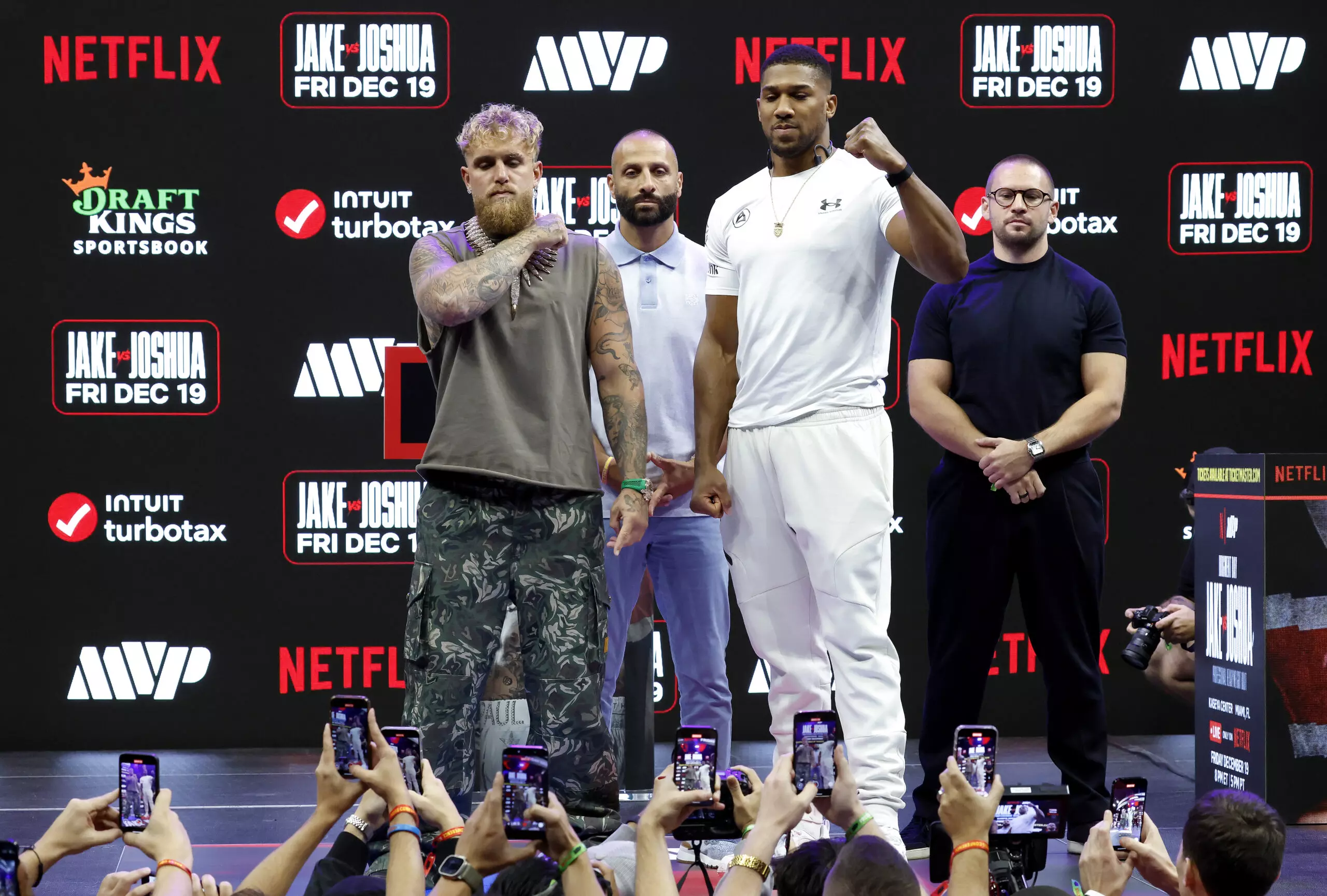
There are moments in boxing when the improbable doesn’t just knock on the door—it kicks it down, lights up a neon sign, and dares the world to look away. Jake Paul vs Anthony Joshua is exactly that moment, a collision course between YouTube stardom and the battered grandeur of heavyweight royalty. But the differing backgrounds of the two protagonists have divided debate among both pundits and fans alike.
The brash American Problem Child is boxing’s ultimate disruptor. Paul has ripped up the script of how to become one of the fight games’ biggest stars, powering his way into the spotlight by fighting and beating a slew of washed-up former UFC fighters, such as Anderson Silva, Nate Diaz, and Mike Perry, selling 2.75 million pay-per-views for over $150m in the process. His battle with a 58-year-old Mike Tyson late last year took the world by storm, becoming the most-watched fight ever courtesy of the backing of streaming giant Netflix, even if the clash was ultimately a drab affair.
Joshua, by contrast, is British boxing royalty. A 2012 Olympic Gold medalist, AJ is a two-time world heavyweight champion, holding knockout wins over the likes of Wladimir Klitschko, Alexander Povetkin, and former UFC heavyweight king Francis Ngannou. However, back-to-back losses to former undisputed champion Oleksandr Usyk as well as a brutal knockout defeat to compatriot Daniel Dubois at Wembley last September have pushed Joshua away from the title picture.
Jake Paul vs Anthony Joshua – Paul’s hunt for the suspect chin
AJ hasn’t fought since that knockout loss to DDD under the arch, and was set to fight some kind of tune-up fight in December against an unheralded “top 100” ranked heavyweight as he prepares for a clash with Tyson Fury next year. Rather than any old heavyweight tomato can, however, he has instead opted to accept the offer presented to him by young Paul, still treating it as a warm-up, but now receiving in the region of $90m for his troubles.
The huge difference in size and ability between the two fighters has the pundits calling the clash a farce, even indicating that if AJ doesn’t secure a first-round knockout victory, then the clash is a fix. Paul, however, points to Joshua’s suspect chin, a chin that has been rattled numerous times before by the likes of Andy Ruiz, Klitschko, and Dubois. Much like the poker masters at ignitiongaming.net/au/, you can expect to see the Problem Child going all in in a bid to test that chin as early as possible. But as those poker gurus will tell you, pushing all of the chips into the middle is the highest risk strategy one can ever take.
Despite all the critics circling Jake Paul vs Anthony Joshua, boxing has always been prone to its freak shows. Its circuses, if you will. Here are three other times in history when boxing served up cross-over mismatches that divided opinion across the board.
Floyd Mayweather Jr. vs Conor McGregor
When Floyd Mayweather Jr. returned from his retirement to face Conor McGregor, the world tuned in. Under the heat lamp of a Las Vegas August, nerves frayed, and press conferences devolved into wild verbal tirades spread across a four-city world tour. Ultimately, however, the bad blood worked wonders, with the fight between the man known as ‘Money’ and the UFC’s undisputed top star – and reigning featherweight champion – racked up $600 million in estimated revenue and 4.3 million PPV sales, second most all time after Mayweather vs Pacquiao.
The stats told a bizarre story: McGregor, a boxing novice, led the punch count early (51 landed to Mayweather’s 40 by the third) before Mayweather bore down, dispatching 130 power shots in the back half and prompting a 10th-round stoppage.
Experts branded the clash as an exhibition in disguise. Yet, beneath the pageantry, the fight exposed the tectonic shift in audience expectations. What mattered wasn’t just the bout, but the subtext—two of the planet’s biggest superstars meeting in the ring to deliver a showcase for the ages… Even if there was a huge gulf in class in genuine boxing ability.
Tyson Fury vs Francis Ngannou
The next act for the circus tent came under Riyadh’s stadium lights. Tyson Fury entered the Arabian Gulf as a colossus, unbeaten, untouchable, and the reigning WBC world heavyweight champion. Francis Ngannou, meanwhile, walked away from his UFC heavyweight championship, citing pay issues, instead heading to the squared circle for the biggest payday of his career against the Gypsy King, and by some distance. The odds? David versus Goliath without the slingshot.
Only, boxing’s gods have a sense of irony. Ngannou detonated a left hook in round three that sent Fury sprawling—his first legitimate knockdown since facing knockout artist Deontay Wilder, and a statistic that rattled every projection. Punch stats exposed the nerves: Fury connected on 131 to Ngannou’s 104, but it was the Cameroonian’s power and audacious self-belief that dictated momentum. The split decision in Fury’s favor drew howls—“Ngannou was the aggressor,” thundered ringside voices, but boxing judges couldn’t let an MMA fighter win inside the ring on his boxing debut, could they?
Muhammad Ali vs Antonio Inoki
Rewind to a different world—Tokyo, 1976. The Budokan Arena heaved with tension as Muhammad Ali, freshly exiled from American rings, agreed to meet Antonio Inoki, a pro wrestling legend with a point to prove. It was part business, part bravado—and it devolved, infamously, into farce. Inoki’s tactical crab-walking, lashing Ali’s legs with more than 100 ground kicks, reduced The Greatest to throwing a mere six punches. Rules had been amended and re-amended until all that was left was confusion.
The fight ended in a draw, met with bemusement abroad and glee in Japan. But the aftershocks run deep: leg damage threatened Ali’s career, and Western media still wrestle with its meaning. Some call it slapstick tragedy, a precursor to modern MMA; others see it as a necessary, if embarrassing, evolutionary leap.

Michael Kovacs
Michael Kovacs is the Founder and CEO of Last Word On Sports INC. He is a credentialed sports writer having attended many domestic and international sports events. Michael currently oversees more than a dozen websites, and hundreds of writers and editors. He has been featured in major publications such as MSN.com, Bleacher Report, Sports Illustrated, Yahoo, in addition to most of the properties in his portfolio. He graduated from McMaster University (2002) and completed a Master's Degree in Writing at the University of New England (2011). You can find his current writing at: LastWordOnSports.com LWOSports.com MMASucka.com BigFightWeekend.com ExtraTimeTalk.com GridironHeroics.com HardwoodHeroics.com WISportsHeroics.com